Horse Bit Leverage Explained
Leverage is the pounds of pressure transmitted through a horse’s bit per pounds of pressure from a rider’s hands through the reins.
If a rider pulls on the reins with one pound of pressure and the horse’s bit transmits one pound of pressure so that the horse actually feels one pound of pressure the leverage is 1:1.
Some bits are designed to produce one pound of pressure with only a tiny movement of the rider’s hands. This is often desirable in dressage or riding competitions where unobserved horse cues are important. In that case a rider may use only 1/4 pound of rein pressure to give a horse one pound of bit or curb pressure.
If a horse’s mouth has been damaged, formed callouses, been made “hard” it may take a more severe bit with more leverage to give him cues. If a horse has a soft mouth he is said to have a “light mouth” that is very sensitive to small pressure.
Several factors affect the amount of leverage a bit can transmit. (see Bits) (see Shanks)
Shop Curb Horse Bits with snaffle mouth
Bits are balanced differently. Their balance can have a profound impact on release of pressure. (see Release Training) If you draw a line from the top of the bridle ring, down through the butt of the bit and extend it straight down, you will see how a bit is balanced. Do the shanks hang forward of the center line, dead center, or behind the center line? Balance can pressure a horse’s mouth before the rider even picks up the reins. Balance determines how the bit feels as your horse moves his head up or down – how it changes shape in his mouth with his carriage.
Two bits that look identical may have profoundly different balance. You may see experienced horseman in a bit shop hanging each bit on their hand and studying the balance acutely.

A bit that is balanced a little forward of center will fall to its “balanced” position when the reins are dropped and will immediately release pressure. This is very important for training. (see Release Training)
A bit that is straight up and down will apply pressure when the horse’s face is too high or over-flexed and only release to the “sweet spot” of “no-pressure” when it is hanging vertical. That makes it a good bit for Western Pleasure as that discipline requires a horse to carry a vertical face. He will naturally seek out the non-pressure posture and carry his head at the right angle with this type of bit.
A bit that is under-balanced is seldom desirable, as it shortens the “signal” and holds pressure even when the reins are dropped.
Some shank materials are lighter weight than others. An aluminum bit shank will not concentrate as much weight behind center balance of the bit. The actual signal from hand to the shank of the bit is reduced. The release may be negatively affected. In other words, it will not “fall” (release) as decisively because it weighs too little. A heavier shank such as an “S” shank will concentrate more weight behind the center balance of the bit and make a more intense correction due to the increased weight of the shank and its balance point.

Shank Configuration: The length of the shanks are not the only factor affecting the leverage. The butt of the bit is the fulcrum point that works the leverage on the curb strap. The distance between the ring where the head stall attaches and the butt of the mouthpiece is called the “lift”. (see illustration above) The “lift” affects the curb strap action. The longer the “lift” the more exaggerated is the curb pressure and the more vertical the horse will hold his head.
Additionally, the ratio between the lift and the shank length is critical to leverage. The larger the ratio (ie: 4:1), the more leverage is applied with less rein movement and the quicker the signal. Thus a bit with a small lift but long shanks has more leverage.
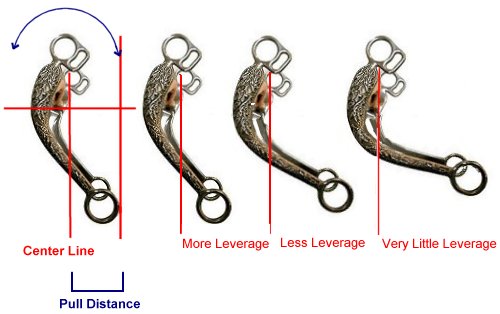
Pull distance is also important (illustration above). The further behind the center line the rein ring is located, the less severe is the leverage and the slower the signal.
Generally speaking, a high leverage bit will encourage a horse to drop his whole neck a little lower; an average leverage will cause the horse to break at the crest of the neck; and a low leverage bit can help to lift the neck and shoulders by encouraging the horse to break at the poll. The right leverage position can really help a high-necked or heavy-shouldered horse stay round and balanced for better performance.
However, as with all leveraged bits, too severe a pull (compounded by leverage) will raise the head because the pressure on the chin is more severe than the pressure on the bars and tongue. One over-pull, and your horse may start throwing his head up under pressure instead of collecting or tucking.
We certainly don’ t know everything. Please share your expertise and experiences. Comment on what is already written or Suggest a Category and Educate us about it. Grow Horse-Pros.com©
That was very helpful. I have ridden in snaffle for years and the nuts and bolts explanation was helpful. Thanks!